
Capillary Rheometer | Capilograph™ | 583
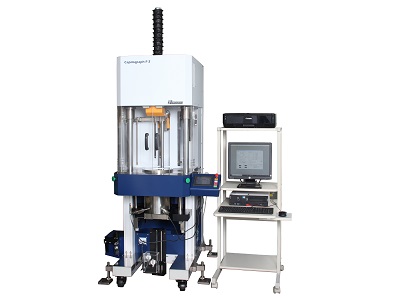
Capillary Rheometer | Capilograph™ | 583
Determination of the fluidity of plastics
The Capilograph measures melt viscosity of polymers by detecting the shear rate and shear stress of melt polymer when it flows out of the capillary die.
Die swell and melt strength can also be measured by equipping it with optional attachments.
The twin bore barrel model (F-2) allows easy Bagley & Weissenberg-Rabinowitsch correction (for determination of true viscosity) or elongational viscosity calculation.
| ISO 11443 | Plastics — Determination of the fluidity of plastics using capillary and slit-die rheometers |
| ASTM D3835 | Standard Test Method for Determination of Properties of Polymeric Materials by Means of a Capillary Rheometer |
– Furnace cylinder can be easily cleaned at the touch of a button.
– Test speed up to 1500mm/min.
– Twin bores specification is added to the lineup.
– Safety door is included as standard.
– Pressure sensor specification is also available. (Pressure sensor specification is also available.)
| Model | F-1 | F-2 |
| Temperature range | 60 to 400°C (500°C optional) | |
| Temperature accuracy | ±1°C (Less than 300°C)
Within ±2°C (300°C or more) |
|
| Number of bores | Single | Twin |
| Bore diameter | Selection:
• ∅9.55mm • ∅15mm |
∅15mm |
| Barrel length | Length: 350mm, effective length: 250mm |
|
| Piston speed | 0.1 to 1500mm/min. |
|
| Force range | • 25kN max (bore dia. ∅9.55mm)
• 50kN max (bore dia. ∅15mm) |
25kN max (bore dia. ∅15mm) |
| Power supply | Three-phase, AC200V, 50/60Hz, 5.2kVA (Main unit) | |
| Compressed air requirement | 0.5MPa | |
| Dimensions | W1060 × D1100 × H1950 to 2360mm | |
| Weight | Approx. 650kg | |
Options
| Pressure transducer | |
| Die swell measurement unit | |
| Melt strength (melt tension) measurement unit | |
| Bagley correction (Optional software) | |
| Automatic data capture software (Optional software) | |
| Elongational viscosity calculation (Optional software) |
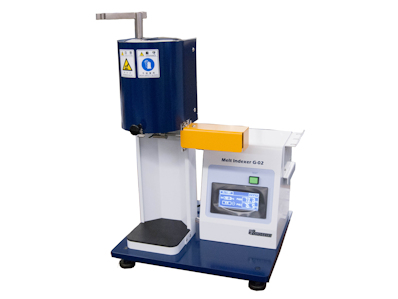 Melt Flow Indexer (Melt Flow Index Tester) | 522-G-02
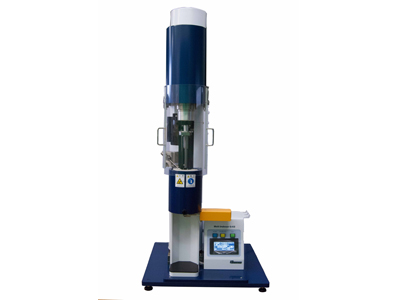 Multi-weight Melt Flow Indexer | 522-G02
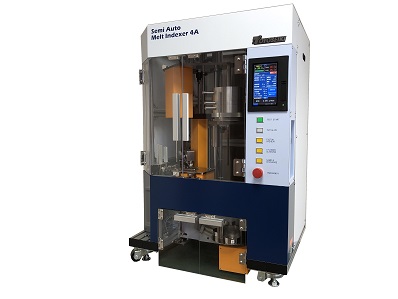 Automated Melt Flow Index Tester / Semi Auto Melt Indexer | 521-4A
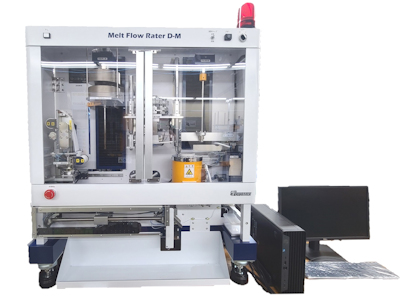 Fully-Automated Melt Flow Index Tester / Melt Flow Rater | 520-D-M
Contact
-
Inquiries from the web
Contact Form -
Inquiries by telephone